Start Me Up Miracle Springs Resort and Spa
Start Me Up, your favorite Rolling Stones Tribute band!
June 6 at The Miracle Springs Resort and Spa
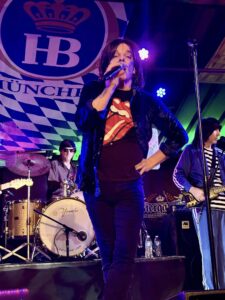
Join us at the World Famous Miracle Springs Resort June 6 for a night of fun and music with Start Me Up, your favorite Rolling Stones Tribute act.
Keith Richards and Mick Jagger became classmates and childhood friends in 1950 in Dartford, Kent.The Jagger family moved to Wilmington, Kent, five miles (8 km) away, in 1954.[3] In the mid-1950s Jagger formed a garage band with his friend Dick Taylor. The group mainly played material by Muddy Waters, Chuck Berry, Little Richard, Howlin’ Wolf, and Bo Diddley. Jagger again met Richards on 17 October 1961 on platform two at Dartford railway station.Jagger was carrying records by Chuck Berry and Muddy Waters; these revealed to Richards a shared interest. A musical partnership began shortly afterwards.Richards and Taylor often met Jagger at his house. The meetings moved to Taylor’s house in late 1961, where Alan Etherington and Bob Beckwith joined the trio; the quintet called themselves the Blues Boys.
In March 1962, the Blues Boys read about the Ealing Jazz Club in the newspaper Jazz News, which mentioned Alexis Korner‘s rhythm and blues band, Alexis Korner’s Blues Incorporated. The Blues Boys sent a tape of their best recordings to Korner, who was impressed. On 7 April, they visited the Ealing Jazz Club, where they met the members of Blues Incorporated, who included slide guitarist Brian Jones, keyboardist Ian Stewart, and drummer Charlie Watts. After a meeting with Korner, Jagger and Richards started jamming with the group.[8]
Having left Blues Incorporated, Jones advertised for bandmates in Jazz News in the week of 2 May 1962.Ian Stewart was among the first to respond to the ad. In June, Jagger, Taylor, and Richards left Blues Incorporated to join Jones and Stewart The first rehearsal included guitarist Geoff Bradford and vocalist Brian Knight, both of whom decided not to join the band. They objected to playing the Chuck Berry and Bo Diddley songs preferred by Jagger and Richards. That same month, the addition of the drummer Tony Chapman completed the line-up of Jagger, Richards, Jones, Stewart, and Taylor. According to Richards, Jones named the band during a phone call to Jazz News. When asked by a journalist for the band’s name, Jones saw a Muddy Waters LP lying on the floor; one of the tracks was “Rollin’ Stone“. Jones was the band’s “uncontested leader” during its early years and a key to the band’s early success.
1962–1964: Building a following
_(cropped).jpg)
The band played their first show billed as “the Rollin’ Stones” on 12 July 1962, at the Marquee Club in London. At the time, the band consisted of Jones, Jagger, Richards, Stewart, and Taylor.Bill Wyman auditioned for the role of bass guitarist at a pub in Chelsea on 7 December 1962 and was hired as a successor to Dick Taylor. The band were impressed by his instrument and amplifiers (including the VoxAC30). The classic line-up of the Rolling Stones, with Charlie Watts on drums, played for the first time in public on Saturday, 12 January 1963 at the Ealing Jazz Club.However, it was not until a gig there on 2 February 1963 that Watts became the Stones’ permanent drummer.
Shortly afterwards, the band began their first tour of the UK, performing Chicago blues, including songs by Chuck Berry and Bo Diddley.[By 1963, they were finding their musical stride as well as popularity.In 1964, they beat the Beatles as the number one United Kingdom band in two surveys.The band’s name was changed shortly after their first gig to the Rolling Stones.[28][29] Their acting manager, Giorgio Gomelsky, secured a Sunday afternoon residency at the Crawdaddy Club in Richmond, London, in February 1963.
In May 1963, the Rolling Stones signed Andrew Loog Oldham as their manager.He had been directed to them by his previous clients, the Beatles. Oldham, then 19, had not reached the age of majority—he was also younger than anyone in the band— and so could not obtain an agent’s licence or sign any contracts without his mother co-signing.By necessity he joined with booking agent Eric Easton to secure record financing and assistance booking venues. Gomelsky, who had no written agreement with the band, was not consulted.

Oldham initially tried applying the strategy used by Brian Epstein, the manager of the Beatles, and have the Rolling Stones wear suits. He later changed his mind and imagined a band that contrasted with the Beatles, featuring unmatched clothing, long hair, and an unclean appearance. He wanted to make the Stones “a raunchy, gamy, unpredictable bunch of undesirables” and to “establish that the Stones were threatening, uncouth and animalistic”.One of Oldham’s first acts as manager was to remove Stewart from the official line-up, though he would be retained as the band’s road manager and would continue to provide keyboards in the studio and live (initially off-stage, he would eventually play with the band on stage by the mid-1970s). Oldham later said of this decision, “Well, he just doesn’t look the part, and six is too many for [fans] to remember the faces in the picture.” Oldham also reduced the band members’ ages in publicity material to make them appear as teenagers.
Decca Records, which had declined to sign a deal with the Beatles, gave the Rolling Stones a recording contract with favourable terms. The band were to receive a royalty rate three times as high as that typically given to a new act, full artistic control of recordings, and ownership of the recording master tapes. The deal also let the band use non-Decca recording studios. Regent Sound Studios, a mono facility equipped with egg boxes on the ceiling for sound treatment, became their preferred location. Oldham, who had no recording experience but made himself the band’s producer, said Regent had a sound that “leaked, instrument-to-instrument, the right way” creating a “wall of noise” that worked well for the band. Because of Regent’s low booking rates, the band could record for extended periods rather than the usual three-hour blocks common at other studios. All tracks on the first Rolling Stones album, The Rolling Stones, were recorded there.[45][46]
Oldham contrasted the Rolling Stones’ independence with the Beatles’ obligation to record in EMI‘s studios, saying it made the Beatles appear as “mere mortals … sweating in the studio for the man”. He promoted the Rolling Stones as the nasty counterpoint to the Beatles, by having the band pose unsmiling on the cover of their first album. He also encouraged the press to use provocative headlines such as: “Would you let your daughter marry a Rolling Stone?”] In contrast, Wyman says: “Our reputation and image as the Bad Boys came later, completely there, accidentally. … [Oldham] never did engineer it. He simply exploited it exhaustively.”] In a 1971 interview, Wyman stated, “We were the first pop group to break away from the whole Cliff Richard thing where the bands did little dance steps, wore identical uniforms and had snappy patter.”
Join us June 6 at the Circle Springs Resort and Spa
Start Me Up!!